INTERA Group
- Services
- Web Design, Webflow Development
- Sector
- Tech & SaaS
- Year
- 2026
Introduction
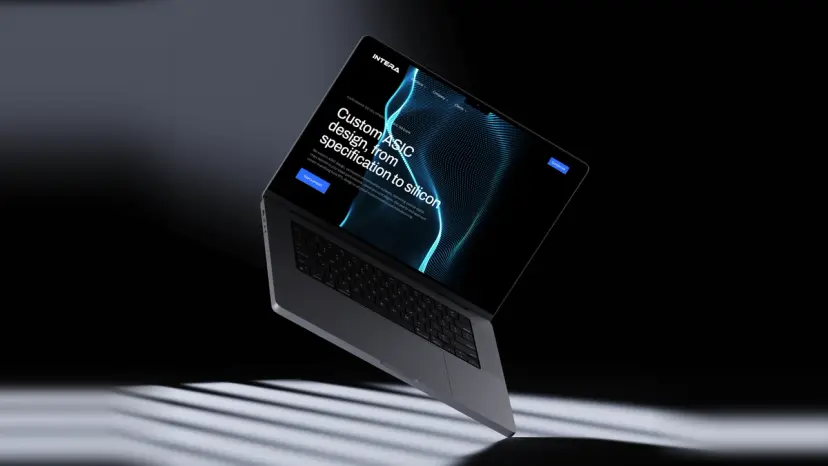
INTERA is the semiconductor and artificial intelligence brand of a Barcelona technology group formed by the merger of NVISION and Sensing & Control: AI accelerators, custom chips, embedded AI and IoT platforms. Of all the group’s websites, it is the busiest: new products, partners, news, trade fairs, job openings. But it ran on WordPress, on a visual builder and a stack of plugins, and anything beyond posting a news item went through their provider, very professional but fully booked: a one-day fix could sit in the queue for three weeks. They could not even add a few filters to the partners page themselves. "With WordPress, what we’ve ended up with is something that isn’t flexible," they told us on the first call. Their requirements list put it plainly: a CMS that marketing can truly run on its own.
The migration
The website their clients already knew, on a platform with no plugins to maintain
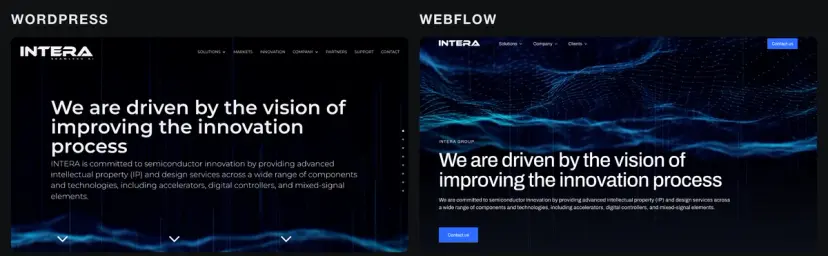
There was no need for a new website: the message worked and the brand was well established. What was needed was a different platform. So we proposed a migration, not a redesign: we inventoried the site page by page, decided what stayed, what was merged and what went, and rebuilt it in Webflow with the same order and the same messages.
Along the way we polished the design: typography, heading hierarchy, spacing, consistent colours and a menu cut down to three groups (solutions, company and clients). Nineteen fixed pages in all, plus one for every news item, job and resource: the home page, eight solution pages (from AI models to ASIC and FPGA chip design), company, partners, careers, news, support, contact, the Learning Center and the legal pages.
The content
A news item, a job or a partner is one form to fill in; the page builds itself
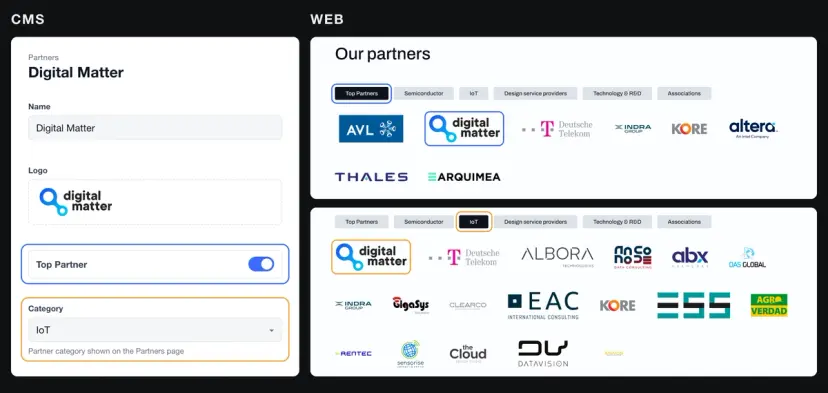
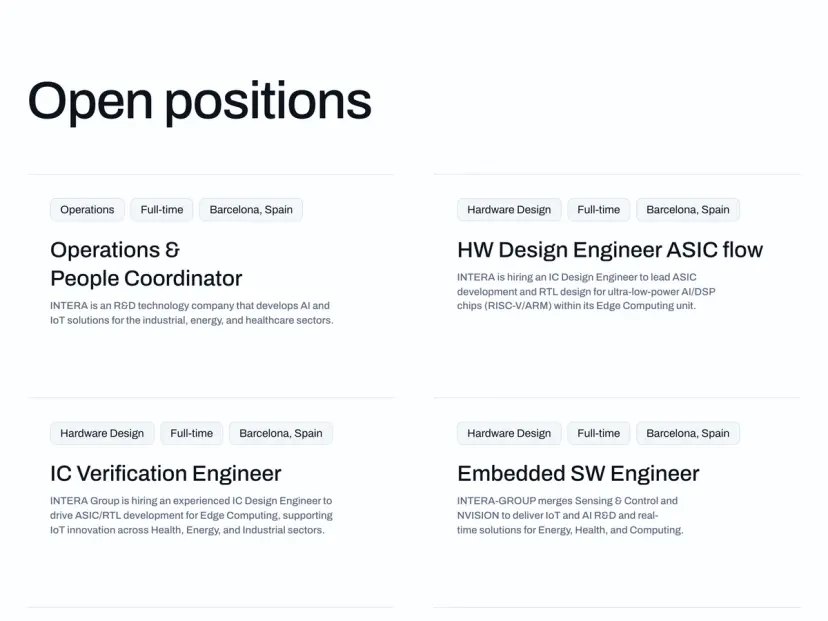
All the content that changes often is now a CMS collection, a kind of spreadsheet with its own columns: the twenty-nine partners, the job openings, the news, the clients on the home page and the Learning Center resources. We imported the old site’s news and job posts in one go. Every news item and every job gets its own page automatically, with its title and description for Google, and even the fields say what they expect: the client logo asks for a white or transparent background and 500 KB at most.
The partners page was the acid test. On WordPress it was some thirty logos stacked down one page under headings, with no filter, and adding one depended on the provider. Now every partner is an entry with its category and a box to mark it as a top partner, and the page sorts them into its tabs by itself. The pieces that repeat (service, news and job cards, the menu, the footer) are components: the text changes in each one, and the design lives in one place.
Autonomy
The team changes what changes every week; the design stays untouched
Autonomy does not mean touching everything; it means being able to change what changes every week with no risk of breaking the rest. The agreement is that the team works in the Webflow Editor, where they can change the content but not the design, and that the structure and the styles live in the Designer, the design tool, which we look after. We wrote it down in a guide and went through it in a training session after launch: publishing a news item, opening and closing a job, what to touch and what to leave alone.
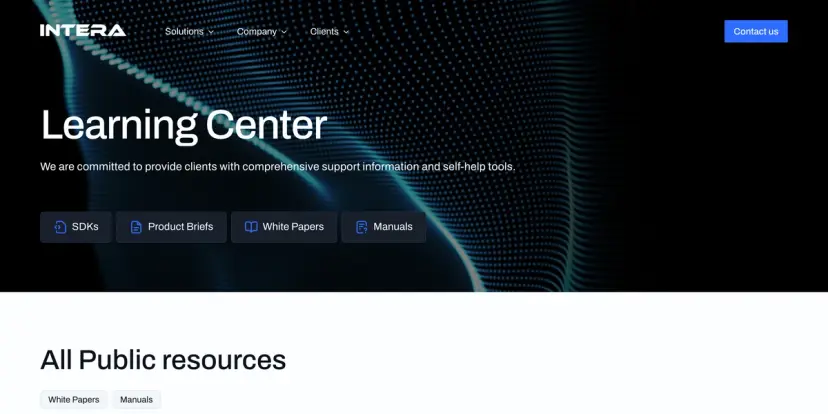
Roger Avellana, the marketing team’s visual designer, came to the session with a list of questions, and that same week he took a client’s logo off the home page himself. The website is theirs, and they hold every permission. The Learning Center, the technical documentation hub for clients and partners, fills up the same way: each resource is an entry with its category and, when it has one, its download.
In short
A website built to change at INTERA’s pace, and for its own team to make the change.
 Webflow